

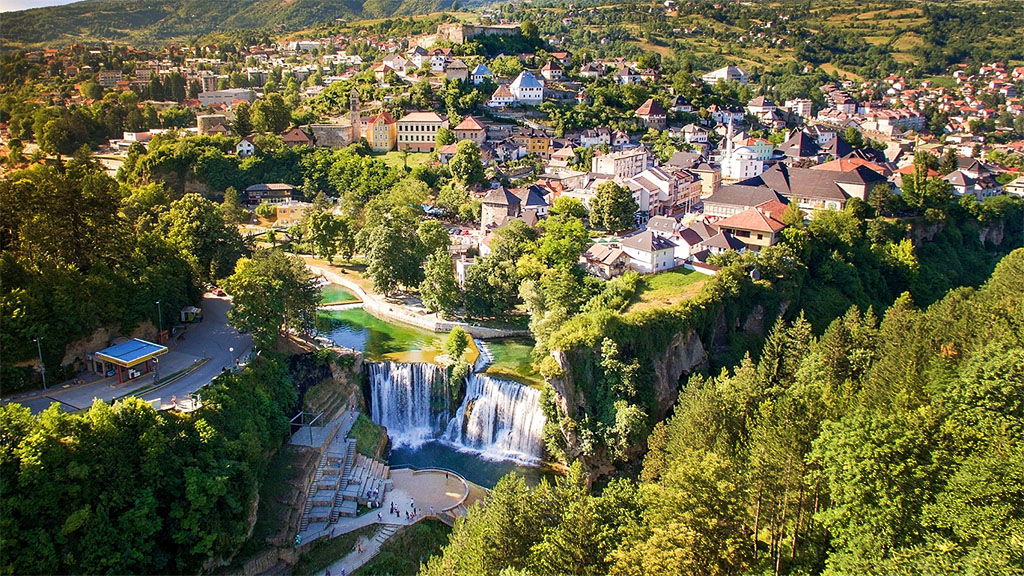
Bosnia and Herzegovina, with about 4 million inhabitants, occupies a territory of 51.233 km2 in the Balkan Peninsula of Southeast Europe. Until 1992, it was part of the former Yugoslavia. In its entirety, Bosnia and Herzegovina is one of the most interesting parts of Europe, and it is particularly rich in cultural diversity. Influences of Christian culture from the West — Roman
Catholic and Eastern Orthodox , and the Orient — Islamic, Moorish and Jewish , are found throughoutthe country. Their symbiosis during a long period of relative peace had great impact on the development of local architecture, sculpture, literature and music.
Every historical period has left indelible traces. Among the oldest are a cave drawing in Badanj near Stolacand an archaeological find in Butmir, over 4000 years old. In addition, remnants of Illyrian settlements have been found in Ošanići and Ripač. Also interesting are structures from the era ofthe Roman Empire,such as the Roman Bridge and a bath complex in Ilidža on the outskirts ofSarajevo.
The Ottoman Empire left indelible traces in BosniafHerzegovina. For about two centuries trade flourished in the region,and local culture is still deeply marked by Turkish and Muslim traditions. This period saw the foundation of cities, such as Sarajevo, Mostar and Tuzla; the development of architecture; the erection of famous bridges in Višegrad, Mostar and Žepa; the building of trade roads, caravanserais, hamams (Turkish baths) and mosques; and the establishment of schools and libraries in larger settlements.
A new boom in the development ofthe country came at the time of its occupation by the AustrofHungarian Empire. The following buildings were constructed during the occupation: the City Hall, the Cathedral, the National Museum, the National Theatre, and someothers.
The first half ofthe twentieth century adversely affected the situation in the country: two world wars, heavy loss of life among the population, the territory of the country occupied and partitioned by the warring powers.
The second half of the twentieth century was marked by progress on all fronts, rapid development of industry, and the expansion of cities, as well as by the greatest sports event in the history of BosniafHerzegovina, the Winter Olympic Games held in Sarajevo in 1984.
When the last war ended in 1995, reconstruction efforts on the most important cultural monuments were initiated, with the aim of reviving the tourist industry in Bosnia Herzegovina.
Information for tourists
Area: 51.209,2 km2
Population: 3.531.159 (2013)
Capital: Sarajevo
Major cities: Banja Luka, Mostar, Tuzla, Zenica
Time zone
Central European Time Zone (GMT +1).
Religions
The most prominent religions are Islam, Orthodoxy, Catholicism, and Judaism.
Power supply
220V with frequency 50Hz.
Water supply
It is safe to drink tap water in Sarajevo.
Measuring system
Metric system
Currency
The currency used in BiH is the Convertible Mark. The international abbreviation is BAM, while the abbreviation KM is used in BiH. 1 € = 1,95 KM.
Important phones
Police 122
Fire department 123
Emergency 124
Rescue service 121